I. Substratum
(1) The singular fear/feat is the approximation to the object.
(2) The concepts flow, sperm-like, towards the singularity.
(3) The singularity is approached in a slouching procession, and it is ultimately the hypotenuse of the distance which becomes the objectified concept.
(4) The singularity is ultimately the abstract disillusionment of the Pythagorean theorem.
(5) We jot this down.
***
Which is to say that the pithy statements of Ecclesiastes might still be applicable: no barriers have yet been breached. The sex appeal of the epistemic break might be conjectured as an appeal to collective identification—a need for novelty and differentiation.
In this sense, time and space have always been conceptualized as a miasma of discrete coincidences. The epistemic break would therefore be an appeal to the higher delegates of futurity. “We saw the same things you are seeing,” they whisper, “this is how we was dealt [sic].”
The desire for trans-generational communication is expressed in the individual in the form of mysticism and a belief in divination. No need to rail against the priestly class here or to summon Nietzsche from his monastic abode in the Alps. It suffices to say that removing the veil is as old as the veil itself. A veiled woman, nervous about death, visits the man everyone fears and respects: she unveils herself. The man breaks the bones of a stag, burns the animal’s scapula, and by the art of scapulimancy reads the woman’s fate. Historicism might be the culprit here, the stultifying delegate of this higher court of appeals. It would be easy to blame Schleiermacher for his allegorical hermeneutics, but the line goes all the way back to Greek cultural anxieties.
Allegoreosis (ἀλληγορία)
“Reading is dramatized not as an emotive reaction to what language does, but as an emotive reaction to the impossibility of knowing what it might be up to.”
– Paul de Man
‘Literal’ ether historial vndurstondyng techith what thing is don; allegorik techith what we owen for to bileue. Bible (Wycliffite, L.V.) Isa. Prol.,.
II. Prefiguration
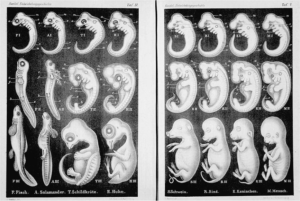
Geist—Hamlet’s Ghost—finds its resolution in the spark of a ganglial fold in Vienna, during the mirror stage of the 20th century. The specter of biologism reaches a crescendo with Ernst Haeckel’s uncanny anatomical progressions. The idea that ontogeny replicates phylogeny sounds like vulgar Marxism to contemporary sensibilities; the same goes with Freud’s recourse to ethnography in Totem and Taboo. The Eurocentric arched eyebrow, The Golden Bough, incest, parricide, and the stench of formaldehyde emanating from the increasingly anthropomorphic embryos—everything reeks of obsolescence.
Freud: ultimate truth or desuetude? This is the doubt of the contemporary subject. In this sense, Ricoeur acts like a mediating Jesuit between querulous lovers. “Give him some credit, look at the way he builds his epistemology in between science and culture. Remember when he was still confused by the anatomic? Remember the evolving topologies and revolving economies? Where were you when Freud broke the dome of the sacred? I know, in utero.
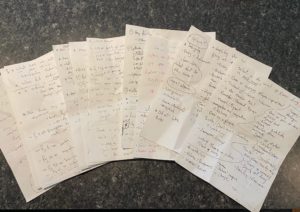
“Topic for poem—School Children &
the thought that life will waste them
can
perhaps that no possible life fulfill
their own dreams or even their teacher s
hope. Bring in the old thought that
life prepares for what never happens.”
– W.B. Yeats, March 1926
III. Apocatastasis (ἀποκατάστασις )
Yet, the fully developed embryo—containing all of the creaturely atavisms in conflict with external, contingent demands—never completes the cycle of gestation. It can only remain in flux, in a state of constant oscillation between the possibility of abortion and the initiation into an Oedipal drama that has already begun—one that he must ultimately sublimate. Fully grown, the adult retains the dichotomous chrysalis of childhood: the shadow of an abortive death and the cost of symbolization.
“O chestnut tree, great rooted blossomer
bole
Are you the leaf the blossom or the bowl?
dance ‘s so
O dance where everything is finely done
How can we know
It seems that the dancer & the dance are one.
O dance, are footfall, shoulder, glittering
O blazing foot, O glittering glance”
– W.B. Yeats, June 14, 1926
The necessities of Ananke preclude the possibility of a resolution. The psychic apparatus, inscribed and encrypted in dichotomous symbols, sublimates this impossibility, ironing the creases pars pro toto. Analogy, metonymy or metaphor, are you mere parallelisms? Do I reify you when I address you as an object? Am I myself displaced when I construct you?
But we must not veer into the cul-de-sac of romanticism or regress to the solipsism of the preconscious Herr-Doktor. Let us stay recapitulating the gestation period as the inevitable recurrence of scientism and romanticism. This has long been understood. Two historical examples suffice: On the one hand, the Nietzsche of Nietzsche Contra Wagner rages against the atavistic excesses of The Birth of Tragedy, and yet accepts it as a youthful rebellion and as a developmental necessity in his system. Lukács, on the other hand, steeped in Marxism after regressing to the Mother in the object of Soviet Russia, renounces the youthful findings of his Theory of the Novel. Who completes the circle, the deranged philosopher who allows or the orthodox critic in the garb of his censors? Only Ananke presumes to understand, and it is her impossibility that frames our referents. In scientific terms, Ananke is the control group—natural and unpredictable—and the artwork, under the aegis of play, is the experimental group. The artwork is safely regulated and symbolically accessible. In the encounter with the artwork the recapitulated subject re-creates the dreams of a lasting conflagration.
***
Post-stratum: Yeats continued to revise the poem after its publication in 1928. Cf. The Tower (1928) Manuscript Materials (Ithaca: Cornell Univ. Press), 2007